


This article is a guest post from Dazzle, Europe’s first platform to match organisations with pre-screened sustainability professionals. Plan A and Dazzle have partnered to combine a platform offering with expert services to complement it.
In the business world, there is no denying that some people still hear the word ‘sustainability’ and instantly feel a sort of shudder. What is the next regulation they are going to be hit with? And when do they need to comply with it?
But from our experience over the past couple of years, many people are starting to see past this unnecessary fear and are instead getting excited by sustainability. They are seeing that when companies go beyond just meeting expectations, and embed sustainability deeply and holistically, it becomes a powerful driver of long-term business performance. It inherently leads to cutting costs, driving innovation, and strengthening resilience in the face of economic and environmental change.
But as sustainability becomes more integral to how companies succeed and grow, it is also becoming more complex to manage. From data collection and emissions tracking to risk management and strategic decision-making, it now touches nearly every part of an organisation. So if you want to get sustainability right today, you need to know how to structure it effectively. The companies already leading the way are those combining three essential elements: strong internal ownership, powerful digital tools, and specialised external expertise.
In this article, we will explore how these three elements come together in practice, with realistic examples, and a step-by-step guide to building a sustainability management system that drives measurable results and supports continuous improvement, for 2026 and beyond.
The 3 key elements of modern sustainability management
No single department, function, tool, or consultant is going to magically help you manage sustainability effectively today. But by combining the three elements below in the right way, you can build an efficient system that turns complex sustainability goals into tangible results.
1. In-house teams: building ownership and long-term alignment
Strong internal teams form the backbone of effective sustainability management. They ensure governance, accountability, and alignment with business goals.
The idea is to harness your in-house teams to embed sustainability into long-term decision-making, rather than treating it as a standalone initiative. This is essential for maintaining institutional knowledge and continuity, ensuring that progress is not lost as strategies evolve.
2. Digital tools: enabling speed, accuracy, and scale
Modern sustainability challenges require managing vast amounts of data. Calculating emissions across operations and supply chains, analysing trends to guide smarter decisions, reporting under ever-evolving sustainability frameworks, you name it.
Digital platforms such as Plan A make this possible by automating complex data collection, calculation, analysis, and reporting tasks. It is these platforms that can provide the speed, precision, and transparency your company needs to operate at scale, freeing your internal teams to focus on insights and action rather than manual processes.
3. External experts: adding agility and deep expertise
Even with strong internal teams and digital systems in place, most organisations will also require specialist support at key moments. External experts, such as the pre-screened sustainability consultants available through Dazzle, bring agility, targeted expertise, and flexibility to fill capability gaps, accelerate projects, and address specific or emerging issues that require specialist knowledge.
By complementing internal capacity rather than replacing it, these external experts can help you move faster, avoid costly missteps, and deliver tangible results with confidence and consistency.
They can step in to manage complex assessments, guide strategic initiatives like CSRD reporting or SBTi validation, or provide interim sustainability support when key roles are vacant or on leave. Basically, they can offer whatever specific help you need, whenever you need it.
And by complementing internal capacity rather than replacing it, these external experts can help you move faster, avoid costly missteps, and deliver tangible results with confidence and consistency.
Believe us, if you can get these three elements working together in harmony, you will have created a sustainability management system that is efficient, resilient, and effective.
How these three elements work together: Practical examples
Before we get into showing you how to put such a system into practice, imagine how these elements might work together in the real world. Just consider the examples below.
Example 1. Turning emissions data into energy savings
An in-house operations team uses Plan A’s solution to map emissions across production sites and transport routes. The platform highlights inefficiencies and key reduction opportunities that were not previously visible. Acting on these insights, the company partners with a Dazzle sustainability consultant to design and implement a practical energy efficiency plan, improving performance, reducing costs, and cutting emissions simultaneously.
Example 2. Tackling supply-chain hotspots with expert collaboration
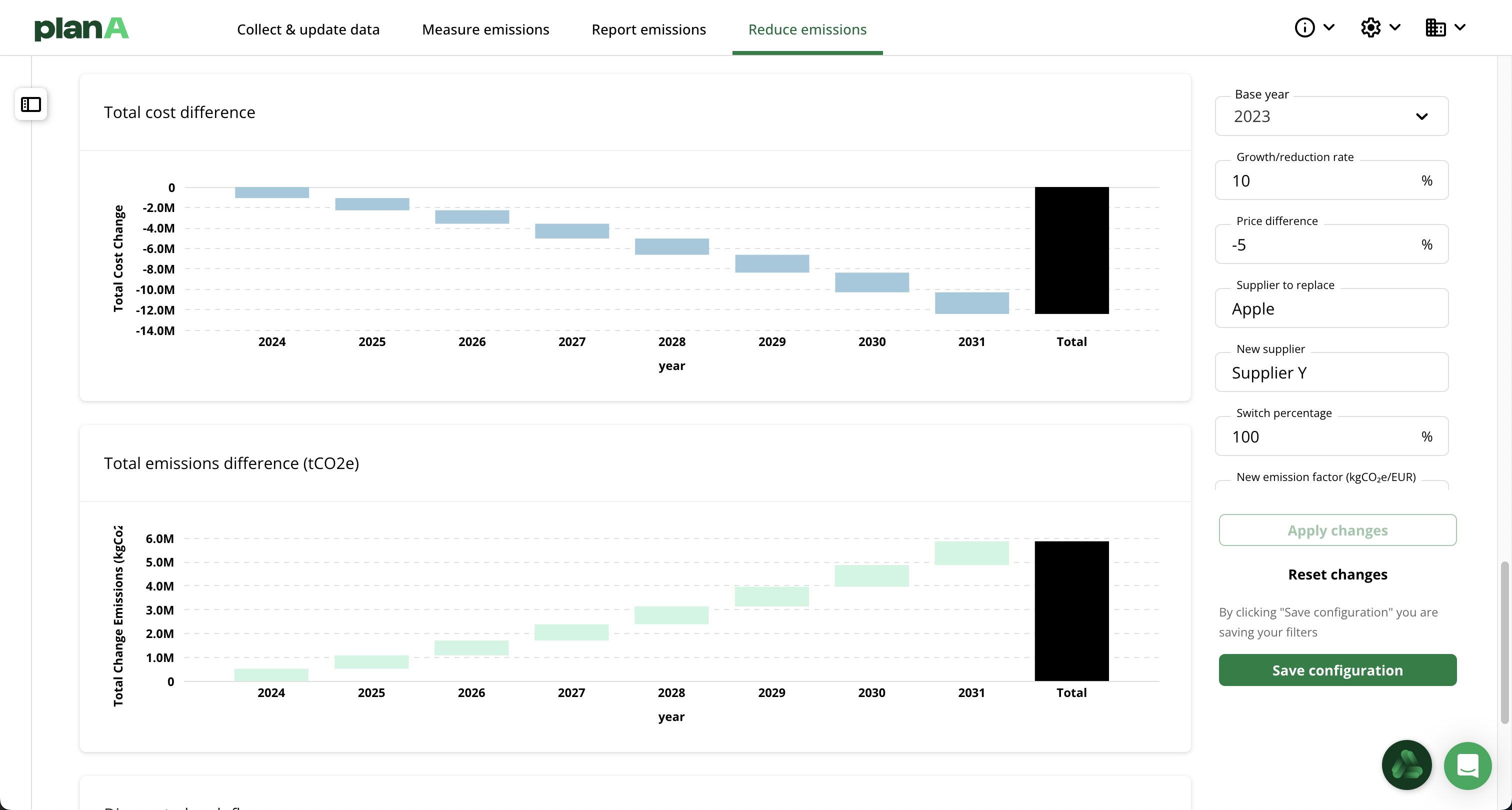
A sustainability manager uses Plan A’s solution to efficiently collect and analyse energy and supplier data, calculating the company’s Scope 1–3 emissions. The results reveal material sourcing hotspots driving the bulk of the footprint. To address this, the company brings in a Dazzle supply-chain decarbonisation expert to engage directly with suppliers, co-develop tailored reduction strategies, and create shared accountability across the value chain.
Example 3. Simplifying complex Scope 3 challenges
A global retailer quantifies its operational footprint using Plan A’s solution, but struggles with the complexity of Scope 3 emissions. To overcome this, they partner with a Dazzle Scope 3 specialist to refine methodologies, collect supplier data, and ensure accurate value-chain calculations. Plan A then becomes the central platform for tracking progress across all categories, providing transparency for both internal teams and external stakeholders.
Example 4. Setting and tracking science-based targets
A growing tech company uses Plan A’s solution to model its baseline emissions and future reduction scenarios. As their ESG lead is not familiar with every detail of the SBTi framework, to ensure alignment with global best practice, they choose to collaborate with a Dazzle SBTi consultant to define and validate near-term and long-term science-based targets. While the consultant manages alignment with SBTi’s requirements, Plan A’s solution is used to continually track progress, automate reporting, and provide the data needed to stay on course.
From these examples, we can see how in-house ownership, digital automation, and specialist expertise can complement one another to overcome key sustainability challenges, and ultimately, to achieve goals.
But we know it can work. Of course, the key question here really is not whether it can work, it is, how do you make it work?
Putting sustainability into practice: step-by-step

To begin with, it is important to remember that there is no ‘one-size-fits-all’ way to approach this in terms of the specifics. Finding the perfect balance between the three elements will look a little different for your company than it does for the next one.
Step 1: Define what must stay in-house
There are some things that companies almost always need to keep internal, because they require institutional memory, authority, or continuity that external experts cannot easily replicate. Your in-house team provides the foundation for accountability and consistency. They should be the ones who own the decisions, uphold standards, and carry progress forward beyond individual projects. With this in mind, you should consider the areas below as ones that belong firmly inside your company:
- Accountability and governance: This means ensuring that sustainability is embedded into structures, policies, and leadership oversight. You can of course bring in external consultants to help implement this initially, but moving forward, it is imperative that it becomes an internal function.
- Decision authority: This is about defining who has the authority to make sustainability-related decisions. Decisions such as approving targets and budgets, or integrating sustainability into product, procurement, or investment choices for example. Again, external experts can help set up clear decision frameworks to begin with, but over time, this authority should be established and exercised internally.
- Compliance responsibility: Ensuring accurate and transparent reporting is essential for maintaining both trust and compliance. External consultants can support with disclosures and help interpret evolving regulations, but the ultimate accountability, both legal and reputational, must remain internal.
- Data ownership: The accuracy and integrity of sustainability data depends on clear internal control. While digital platforms and external partners can assist with gathering, verifying, and analysing information efficiently, responsibility for managing and safeguarding that data should always rest with your organisation.
- Cultural continuity: If you really want your sustainability efforts to have a long-term impact, it is crucial to keep sustainability values alive through leadership example and everyday decision-making. In many cases, organisations turn to external consultants to help shape culture and design engagement programmes. But embedding those values into daily behaviours and internal leadership for the long-term must come from within.
All-in-all, maybe a good way to look at it is something like this: you can outsource expertise, but never responsibility. The authority, governance, and culture that sustain impact must eventually come from within.
Step 2: Identify what to automate
Once you have clearly defined your ownership and governance structure, and you know what your internal capabilities are, the next step is: ramp up the efficiency. Find any repetitive, data-heavy work that slows your teams down, and use digital platforms like Plan A to automate and free up time for your team.
The difference these platforms can make might really astonish you. They can simplify complex data collection, standardise calculations across operations and suppliers, and allow progress to be tracked in real time. Overall, they bring structure, speed, accuracy, and scale. With the right platforms in place, your team can focus less on manual tasks and more on interpretation, strategy, and action.
Find any repetitive, data-heavy work that slows your teams down, and use digital platforms like Plan A to automate and free up time for your team.
If you are wondering where to start with automation, these are the areas top-performing sustainability teams focus on first:
- Data collection and reporting: Manual data entry is not only inefficient, it is prone to error. Automating this process ensures your sustainability data, from energy use to supplier metrics, is pulled directly from the source, verified, and centralised in one system. This saves valuable time and significantly improves accuracy.
- Emissions and performance calculations: Digital tools can instantly calculate and update emissions, energy consumption, and waste metrics across multiple sites. By standardising these calculations, they eliminate inconsistencies and ensure your data is always audit-ready and aligned with reporting standards.
- Monitoring and analysis: Automated dashboards turn raw data into live, visual insights. They enable your team to track key performance indicators in real time, spot emerging trends, and make data-driven decisions faster, without waiting for quarterly reviews or manual reports.
- Framework alignment: Sustainability reporting frameworks are evolving constantly. Automation allows your data to be mapped directly to standards such as CSRD, SBTi, CDP, and GRI, helping you stay compliant and consistent without manually reworking datasets every time criteria change.
When done well, automation with quality software such as Plan A can become the engine behind your sustainability performance, freeing your people to focus on what the technology cannot do: creative problem-solving, decision-making, and cultural change.
Curious how that could look in practice? Explore how Plan A helps leading companies automate their sustainability workflows.
Step 3: Know where to bring in external help
But when we talk about ‘your people’ here, it is rarely a smart idea to limit that solely to your internal team. Because even with a capable internal team and the right digital systems in place, most organisations eventually hit areas where specialist support becomes essential.
Sustainability is vast and ever-evolving, and no single team can realistically cover every area of it in the depth necessary to truly excel. That is where top-quality external experts — such as the ones Dazzle provides easy access to — can make all the difference.
Pre-screened, specialised sustainability consultants provide targeted expertise, flexibility, and fresh perspective exactly when it is needed most. They can fill skill gaps, manage complex or one-off projects, and keep momentum high when internal resources are stretched.
External experts can support you across a wide range of priorities, such as:
- Technical delivery: Managing complex projects like Scope 3 analysis, life-cycle assessments (LCA), SBTi target-setting, or EU Taxonomy alignment can overwhelm internal teams. With expert oversight, these processes remain structured, accurate, and fully aligned with current methodologies, ensuring credible results and audit-ready outputs every time.
- Compliance and disclosure: Preparing or refining reports for frameworks such as CSRD, CDP, or EcoVadis requires precision and consistency. Working with an experienced consultant ensures that your data is always verified, organised, and presented to meet evolving disclosure requirements. This external perspective strengthens accuracy, boosts stakeholder confidence, and helps you avoid the last-minute scramble before submission deadlines. (We’ve got a feeling most readers can relate to that!)
- Strategy and implementation: Having the ambition to design and roll out initiatives like decarbonisation roadmaps, sustainability programmes, or engagement strategies is a great first step, but it will get you nowhere without effective execution. Expert guidance here ensures that these plans are practical, measurable, and fully aligned with business objectives, turning your sustainability goals into tangible outcomes.
- Interim capacity: As we are sure you well know, periods of transition, growth, or leave can stretch resources and stall progress. Enter interim sustainability managers/project management support. By bringing this kind of interim expertise on board when internal capacity is temporarily lacking, you can easily keep initiatives moving forward, ensuring that sustainability momentum is not lost when your team bandwidth is limited.
- Communication and engagement: Sustainability only gains real momentum when it is understood and embraced. With the help of an external sustainability communications expert, your story becomes clearer and more credible, linking your sustainability goals to real business purpose. A consultant can design campaigns that build awareness, motivation, genuine engagement, and that translates your strategy into stories both internal and external stakeholders connect with.
These are just some of the ways external sustainability consultants can accelerate progress, increase flexibility, strengthen delivery, and bring fresh perspective to your sustainability goals.
In as little as 48 hours, platforms like Dazzle can connect you with pre-screened experts who complement your internal team by bringing specialised knowledge, hands-on experience, and the capacity to keep critical projects moving forward. So if the work ever gets too complex, specialised, time-sensitive, or you simply need to fill some expertise gaps fast, the external help you need is always available.
Think you could use that kind of help today? Discuss how Dazzle’s on-demand sustainability professionals can help you complete your sustainability puzzle.
Step 4: Combine for maximum impact
If you implement each of the steps above effectively, your organisation should be well-positioned for genuine sustainability success. But we feel it is important to reiterate here, that the real power of sustainability management lies not in any of these individual elements, but in how they work together. When these forces align, you create a system that delivers efficiency, effectiveness, and resilience. Essentially, a system that just works. The goal is not to choose between internal employees, software platforms, or external experts — it is to orchestrate them in a way that works best for you.
Conclusion: Managing complexity to master the next chapter of sustainability

Sustainability is evolving from ambition to intelligence, where AI, data, and collaboration drive real progress. The organisations already leading the way are those using technology and partnership to turn complexity into advantage.
Within such organisations, in-house teams provide the foundation by setting leadership, governance, and long-term direction. Platforms like Plan A provide automation and AI-driven insight that turn static data into dynamic intelligence: modelling scenarios, predicting risk, and linking emissions directly to measurable ROI. At the same time, stronger supply-chain engagement is emerging as a critical success factor. Companies are partnering with suppliers, sharing data transparently, and co-creating improvements that reduce emissions across entire networks. External experts such as those accessible through Dazzle then add agility and depth, applying specialised expertise to bridge knowledge gaps, strengthen delivery, and build the momentum and confidence that make results stick.The future of sustainability management then lies in intelligent integration. Combining people, technology, and process, while embracing the trends reshaping the business world, and the planet itself. Reach out to both Plan A, and Dazzle today, and together, we can let that trailblazing integration begin.


.webp)